 American Electronic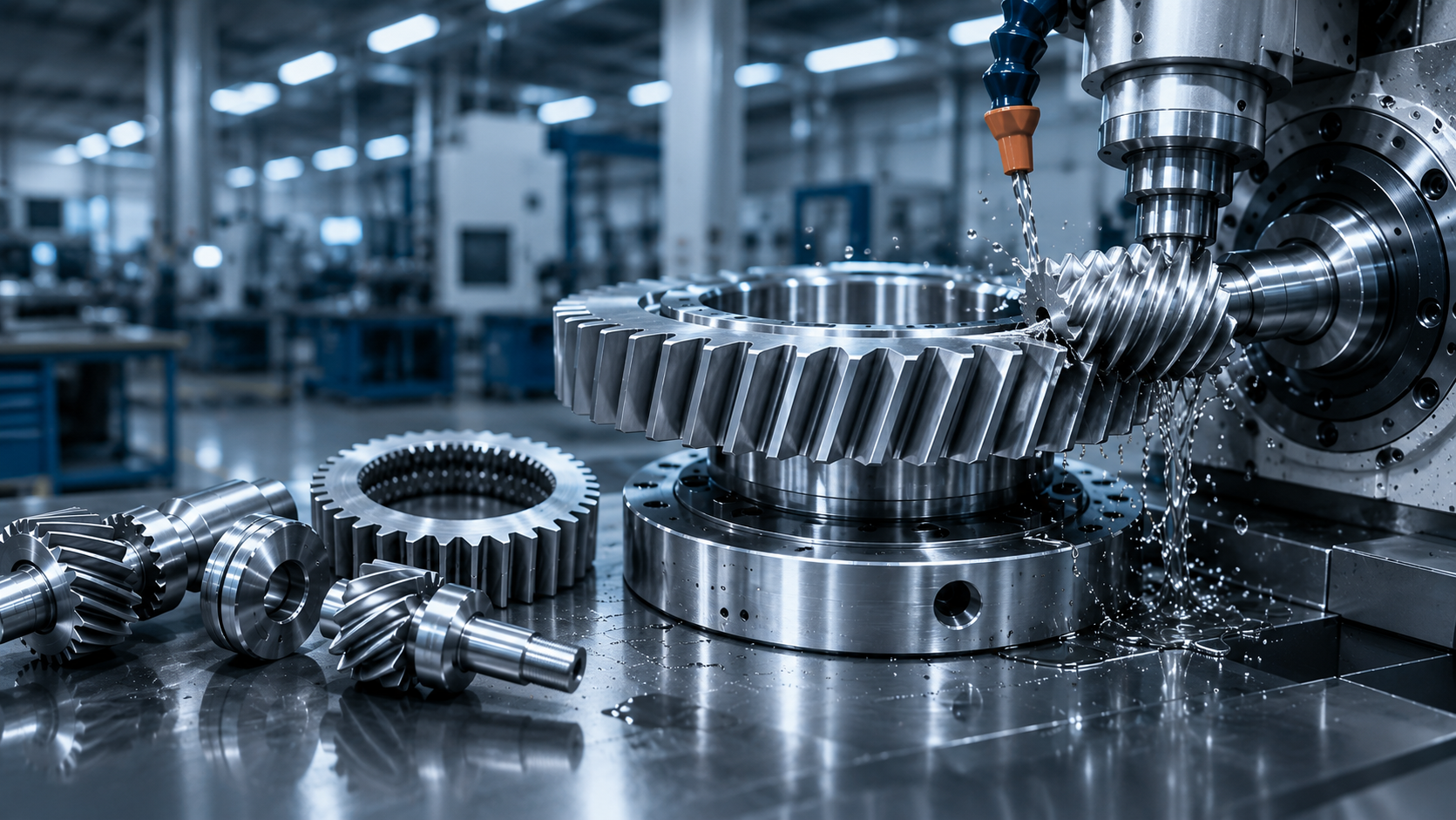
Industrial gears are found in nearly every type of mechanical power transmission system, from electric motors and industrial gearboxes to robotics, pumps, conveyors, and heavy equipment. The performance, durability, and efficiency of a gear system depend heavily on material selection, tooth profile design, machining accuracy, heat treatment, and finishing processes. Understanding how gears are manufactured can help engineers and purchasing professionals make better decisions when selecting a gear supplier or evaluating a custom gear design.
Key Takeaways
- Gear performance depends on the right combination of material, tooth profile, machining process, heat treatment, and finishing method.
- Alloy steels are widely used for industrial gears because they balance strength, toughness, and heat treatability.
- Heat treatment methods such as carburizing, induction hardening, nitriding, and through hardening are selected based on load, wear, and dimensional requirements.
- Precision processes such as gear grinding, skiving, and superfinishing can improve accuracy, noise performance, and long-term durability.
- A complete gear RFQ should include drawings, materials, hardness requirements, accuracy standards, production volume, and application details.
Table of Contents
What Are Industrial Gears and Why Are They Important?
A gear is a mechanical component designed to transmit torque and rotational motion between shafts. While gears may appear simple, their design and manufacturing involve numerous engineering considerations.
Different applications place different demands on gears. A gearbox used in a robotic servo system may prioritize precision and low backlash, while a mining gearbox may prioritize strength and shock-load resistance. As a result, gear manufacturers must carefully select materials, tooth geometry, heat treatment methods, and finishing processes to match the intended application.
Some common industries that rely on gears include:
- Industrial automation
- Robotics
- Electric motors and gearmotors
- Material handling systems
- Agricultural machinery
- Construction equipment
- Automotive powertrains
- Pumps and compressors
- Aerospace systems
Choosing the right combination of design and manufacturing processes is essential for achieving long service life and reliable performance.
Common Gear Materials and Their Applications
Material selection is one of the most important decisions in gear manufacturing. The material affects strength, wear resistance, toughness, machinability, heat treatment response, and overall cost.
Carbon Steel Gears
Carbon steels such as 1045 are commonly used for general-purpose gears where moderate strength and low cost are important.
Advantages:
- Economical
- Easy to machine
- Readily available
Typical applications:
- Agricultural equipment
- Conveyors
- Light-duty industrial machinery
While carbon steels are cost-effective, they generally offer lower strength and wear resistance compared to alloy steels.
Alloy Steel Gears
Alloy steels are widely used for industrial power transmission because they provide a balance of strength, toughness, and heat treatability.
Common grades include:
- 4140
- 4142
- 4340
- 8620
- 9310
Among these materials, 4340 is frequently selected for demanding industrial applications due to its excellent strength and fatigue resistance.
Typical applications:
- Industrial gearboxes
- Mining equipment
- Construction machinery
- Heavy-duty drive systems
Stainless Steel Gears
When corrosion resistance is required, stainless steels may be used.
Common grades:
- 303
- 304
- 316
- 17-4 PH
Applications include:
- Food processing equipment
- Pharmaceutical machinery
- Marine environments
- Washdown applications
Powder Metal Gears
Powder metallurgy can produce near-net-shape gears with minimal machining.
Advantages:
- Low cost at high volumes
- Good dimensional consistency
- Reduced material waste
Applications include:
- Automotive actuators
- Small appliances
- Consumer products
Engineering Plastic Gears
Plastic gears are often used where noise reduction and corrosion resistance are important.
Common materials include:
- Nylon
- Acetal (POM)
- PEEK
Applications include:
- Medical devices
- Office equipment
- Consumer electronics
Understanding Gear Tooth Profiles
Not all gears use the same tooth geometry. The selected tooth profile affects load capacity, efficiency, noise, and manufacturing complexity.
Spur Gears
Spur gears have straight teeth that are parallel to the shaft axis.
Advantages:
- Simple design
- High efficiency
- Lower manufacturing cost
Disadvantages:
- Higher noise levels
- Less smooth engagement
Typical applications:
- Basic gearboxes
- Machinery drives
- Speed reducers
Helical Gears
Helical gears use teeth cut at an angle relative to the shaft.
Advantages:
- Smoother operation
- Lower noise
- Higher load capacity
Disadvantages:
- Generates axial thrust
- Slightly more expensive to manufacture
Helical gears are among the most commonly used gear types in modern industrial equipment.
Double Helical and Herringbone Gears
Double helical gears use opposing helix angles to eliminate axial thrust.
Applications include:
- Large industrial gearboxes
- Marine propulsion systems
- High-power drives
Bevel Gears
Bevel gears transmit motion between intersecting shafts, often at 90 degrees.
Applications include:
- Differential systems
- Right-angle drives
- Industrial power transmission
Worm Gears
Worm gear sets provide large speed reductions in compact spaces.
Advantages:
- High reduction ratios
- Quiet operation
- Potential self-locking capability
Applications include:
- Lifts
- Conveyors
- Positioning systems
Internal Gears
Internal gears feature teeth cut on the inside diameter.
Applications include:
- Planetary gearboxes
- Robotic reducers
- Precision servo systems
Gear Manufacturing Processes
The manufacturing process determines the accuracy, surface finish, and cost of the finished gear.
Turning
Most gear manufacturing begins with machining the gear blank.
Turning operations typically create:
- Outside diameter
- Bore
- Hub features
- Datum surfaces
Proper blank preparation is essential for maintaining concentricity and gear accuracy throughout production.
Gear Hobbing
Gear hobbing is the most widely used gear cutting process.
Suitable for:
- Spur gears
- Helical gears
- Splines
Advantages:
- High productivity
- Excellent repeatability
- Cost-effective for medium and large production runs
Gear Shaping
Gear shaping uses a reciprocating cutter to generate tooth profiles.
This process is particularly useful for:
- Internal gears
- Shoulder gears
- Features inaccessible to hobbing
Broaching
Broaching is often used for internal splines and specialized internal profiles.
Advantages:
- Fast cycle times
- Excellent repeatability
Best suited for high-volume production.
Gear Skiving
Power skiving has become increasingly popular in recent years, especially in automotive and electric vehicle applications.
Advantages:
- Efficient production of internal gears
- Short cycle times
- High precision
As electric vehicle production continues to grow, gear skiving is becoming an increasingly important manufacturing technology.
Gear Grinding
Gear grinding is typically performed after heat treatment.
Benefits include:
- Improved tooth accuracy
- Reduced profile error
- Better surface finish
- Lower noise levels
Applications include:
- Precision robotics
- Aerospace systems
- Servo gearboxes
- High-speed machinery
Many AGMA 10 and higher precision gears require grinding after heat treatment.
Heat Treatment and Gear Hardness
Heat treatment is often necessary to improve gear durability and wear resistance.
The correct heat treatment process depends on the material, application, and required hardness.
Through Hardening
Through hardening increases hardness throughout the entire gear cross-section.
Typical materials:
- 4140
- 4340
Typical hardness:
- HRC 45–57
Advantages:
- Relatively simple process
- Good strength
- Cost-effective
Applications:
- Industrial gearboxes
- Construction equipment
- Heavy machinery
Carburizing
Carburizing creates a very hard outer surface while maintaining a tough core.
Typical surface hardness:
- HRC 58–62
Typical core hardness:
- HRC 30–40
Advantages:
- Excellent wear resistance
- Superior fatigue life
Applications:
- Automotive transmissions
- Aerospace gears
- High-cycle industrial drives
Induction Hardening
Induction hardening selectively hardens specific tooth surfaces.
Advantages:
- Localized treatment
- Reduced distortion
- Good cost efficiency
Applications:
- Large gears
- Heavy equipment
- Power transmission systems
Nitriding
Nitriding creates a hard wear-resistant surface without requiring high-temperature quenching.
Advantages:
- Minimal distortion
- Excellent wear resistance
- Good dimensional stability
Applications:
- Precision gears
- Aerospace components
- High-accuracy transmission systems
Typical Gear Hardness Ranges
While exact requirements vary by application, common hardness ranges include:
| Application | Typical Hardness |
|---|---|
| General Industrial Gears | HRC 28–40 |
| Through Hardened Gears | HRC 45–57 |
| Carburized Gears | HRC 58–62 |
| Nitrided Gears | HRC 55–70 Surface |
Selecting the appropriate hardness is critical because excessive hardness may reduce toughness, while insufficient hardness can lead to premature wear.
Secondary Operations and Finishing Processes
After machining and heat treatment, gears often undergo additional finishing operations.
Deburring
Deburring removes sharp edges and residual burrs created during machining.
Benefits:
- Improved safety
- Better assembly fit
- Reduced contamination risk
Shot Peening
Shot peening introduces compressive residual stress into the gear surface.
Benefits:
- Increased fatigue strength
- Improved durability
- Better resistance to crack initiation
Black Oxide Coating
Black oxide provides light corrosion protection and improved appearance.
Applications:
- Industrial machinery
- General-purpose gear systems
Phosphate Coating
Phosphate coatings improve lubrication retention and assist during break-in operation.
Zinc Plating
Zinc coatings provide enhanced corrosion resistance in outdoor or humid environments.
Superfinishing
Superfinishing further reduces surface roughness after grinding.
Benefits:
- Lower friction
- Reduced operating temperature
- Lower noise
- Increased efficiency
Superfinished gears are commonly found in precision robotics, aerospace systems, and high-performance transmissions.
Choosing the Right Gear Manufacturing Partner
Successful gear production requires more than simply cutting teeth. Material selection, machining processes, heat treatment, hardness requirements, finishing operations, and inspection standards must all work together to meet the application’s performance goals.
When requesting a quotation for custom gears, it is helpful to provide:
- Technical drawings
- Material specifications
- Heat treatment requirements
- Hardness requirements
- AGMA or DIN accuracy requirements
- Annual production volumes
- Application information
Providing complete information early in the process helps manufacturers recommend the most cost-effective production method while ensuring the finished gear meets performance expectations.
At AEP, our engineering team works closely with customers to review gear designs, evaluate manufacturing requirements, and recommend practical solutions for both prototype and production applications. Whether you require through-hardened industrial gears, precision-ground gears, or custom gearbox components, early engineering collaboration can significantly improve quality, lead time, and overall project success.